
How to choose your LLM : Claude, Gemini, ChatGPT and Manus
Claude: precision for expert use cases

If you are looking for an LLM capable of handling complex tasks with a high level of accuracy, Claude remains a solid reference. Anthropic is clearly pushing its ecosystem towards code, long reasoning, computer use, and specialized workflows, with the added possibility of structuring reusable know-how via Agent Skills. Its major advantage is its perceived quality on demanding use cases: code review, dense document synthesis, business assistants, structured analysis, or highly constrained writing. Its main drawback is more operational than functional: Claude performs at its best when the framework, tools, and working rules are well-defined. If you are primarily looking for ultra-native office integration or very spontaneous adoption without framing, other platforms might seem more immediate.
Gemini: The Right Choice if Your Business Already Lives in Google

Gemini becomes particularly relevant when your teams are already working in Gmail, Docs, Drive, Meet, and Google Cloud. Its true advantage isn’t just the quality of the model, but the continuity of use: the AI integrates directly into daily tools, while also scaling up on the build and governance side with Gemini Enterprise and Antigravity. For an organization looking to connect productivity, document context, and business agents within a single environment, Gemini is a highly consistent choice.
Its drawback is almost a mirror image of its strength: the further your stack moves away from Google, the more its natural advantage diminishes. If your IT system is highly heterogeneous or centered around other suites, you will reap the full value of the ecosystem less quickly.
ChatGPT: the easiest platform to deploy within a team
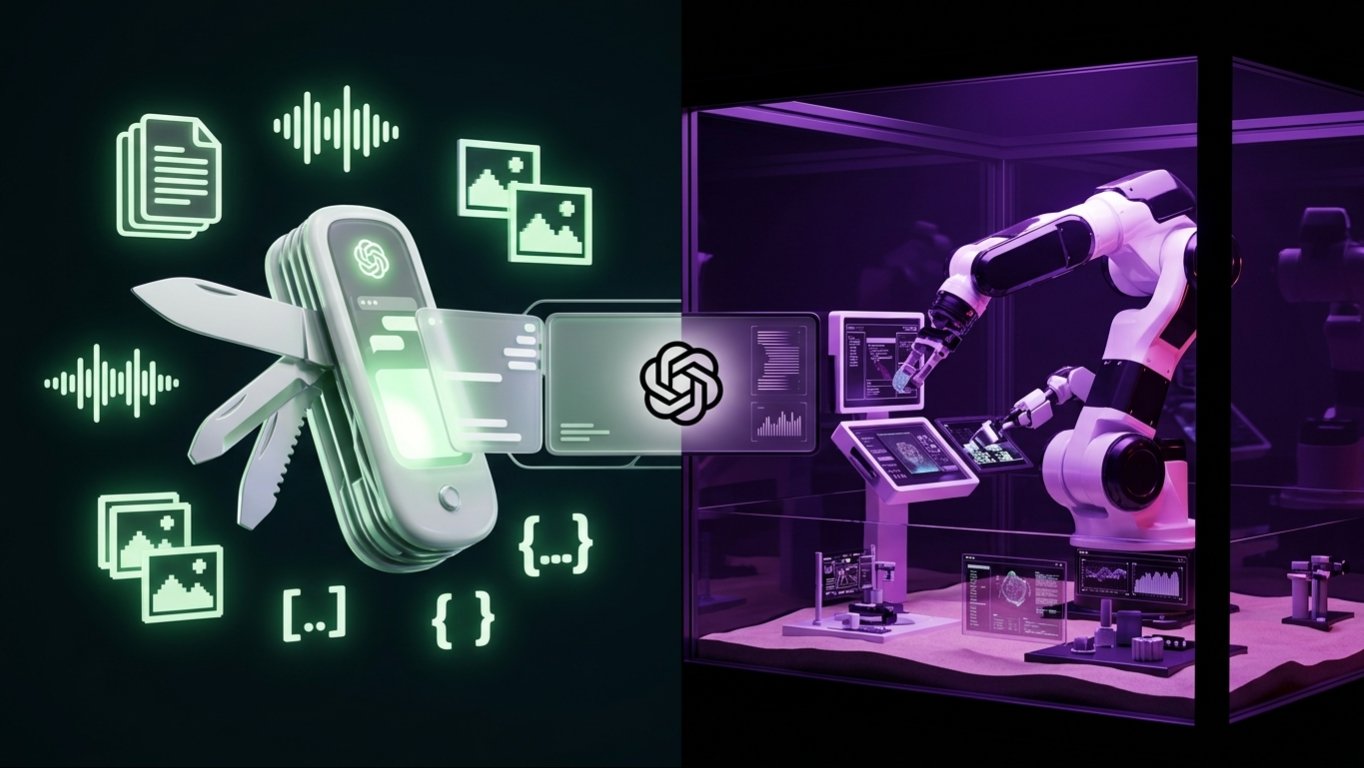
For rapid adoption, ChatGPT often remains the simplest choice. The interface is familiar, conversational use is immediate, and the platform has expanded with apps, connectors, and workspace agents capable of automating shared workflows. Its great advantage is versatility: marketing, support, research, operations, content, prototyping, or internal assistance almost all professions can find a useful entry point without a heavy learning phase. Its main drawback, however, comes from this accessibility: without a clear usage framework, practices quickly become heterogeneous, teams use different methods, and governance can blur between individual, business, and organizational uses. ChatGPT is therefore excellent for moving fast, provided this speed is accompanied by internal standards.
Manus: the option to consider when you want to delegate execution

Manus becomes highly interesting when your need goes beyond a simple answer and approaches actual delegation. The product positions itself as an autonomous agent capable of planning, navigating, operating a browser via Browser Operator, conducting large-scale parallel research, and delivering an actionable result. Its advantage is clear: for monitoring, multi-step web tasks, broad research, or certain operational workflows, Manus can save a considerable amount of time. Its drawback is just as concrete: you must provide it with a precise brief, set an explicit validation level, and monitor credit consumption, as it is not designed as a simple versatile chat but as an execution engine. It is therefore a very good choice if you want to delegate a process, less so if you are primarily looking for a universal conversational assistant.
Conclusion: choosing the LLM that removes the right friction

Ultimately, choosing your LLM comes down to identifying the type of friction you want to eliminate in your work. Claude is often the best ally for expert uses, code, and demanding workflows; Gemini is particularly strong if your organization is already anchored in Google and wants to industrialize agents within a governed framework; ChatGPT remains the best entry point for broad, simple, and rapid deployment across teams; and Manus takes the lead when you truly want to delegate end-to-end execution. The right choice is therefore not the one that impresses the most in a demo, but the one that integrates most cleanly with your tools, your security constraints, your product maturity, and the way your teams work on a daily basis.